
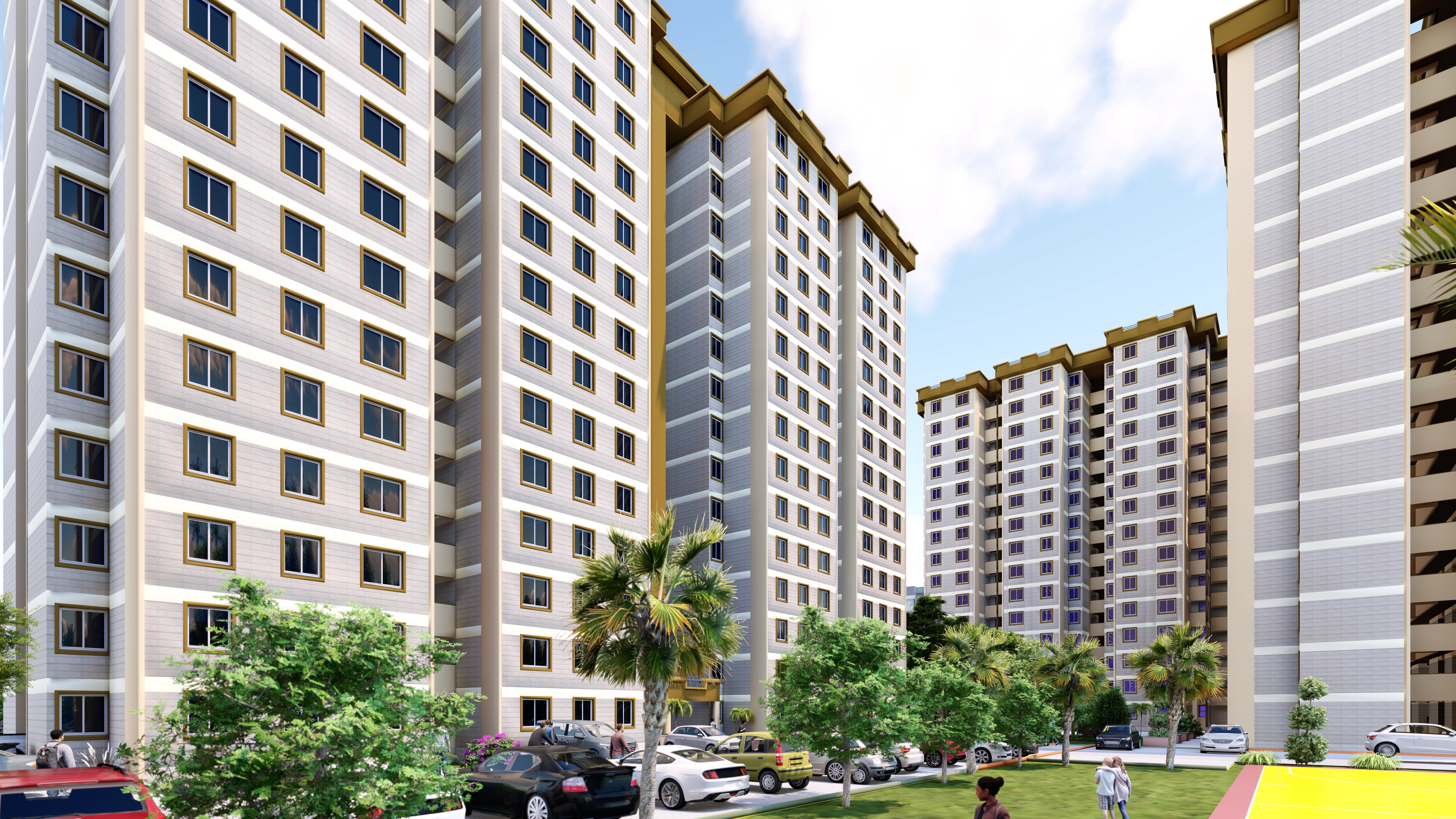
Nearly 4 million urban households in Kenya, roughly the size of Nairobi’s population, spend almost half of their income on housing, which is far above the UN’s recommended 30% limit for affordable housing.
Affordable housing refers to homes that people with average or below-average incomes can reasonably afford, as defined by national or local affordability standards. It also includes safe, modern homes with adequate space, privacy, and access to essential services like transport, schools, and hospitals.
According to the UN’s rule of thumb, housing costs should not exceed 30% of a person’s income for it to be deemed affordable. Urban renters feel the strain most, with housing costs consuming up to 42% of their income as compared to 24% in rural areas. This pressure on household budgets might help explain why home ownership is so low in urban areas. When such a large portion of income goes to rent and utilities, saving for a down payment or covering monthly mortgage payments becomes extremely challenging.
High housing costs are not the only factor, but they add significantly to the difficulty. As a result, only 18% of urban households own the homes they live in, compared to 82% in rural areas. Beyond rent pressures, several structural barriers also make ownership difficult: high initial property costs, mortgage interest rates averaging 12%, large required deposits of 10–30%, short repayment terms with heavy monthly burdens, and strict loan conditions that exclude informal sector workers. Across the globe, countries have experienced and responded to affordable housing differently.
In Germany, rapid industrialization in the early 20th century led to the Gartenstadt or “garden city” movement, where large social housing estates gave working-class families affordable rents in green, dignified environments. By the 1920s and 1930s, government-backed rental estates were central to housing policy, offering stability and fairness. But after World War II, the state shifted emphasis from social rental housing to promoting private home ownership—presented as a path to economic recovery in the aftermath of the war. The irony is that a rental system that had worked well was sidelined in favor of ownership, reflecting economic priorities more than housing need.
Australia, decades later, approached affordability differently. Through shared ownership schemes and first-time buyer grants, the government tried to lower entry barriers to ownership. But grants carried hidden consequences. Take the first-time home buyer grant: it had a cut-off at AU$600,000—meaning you only qualified if the property cost less than that. Sellers quickly pushed prices up to meet the threshold. Instead of homes becoming cheaper, buyers just ended up paying more. This proved that unless supply is significantly increased, financial aid risks helping sellers more than buyers.
USA provides a cautionary tale of Pruitt–Igoe in St. Louis, built in the 1950s with the promise of modern, safe housing for low-income families. Inspired by Le Corbusier’s grand visions of “Radiant City” (Ville Radieuse) concept and his broader ideas of high-rise modernist housing blocks, it should have been a beacon of urban renewal by concentrating residents vertically and free up ground space for open green areas. Instead, relentless cost-cutting stripped away the very features that made projects like the Unité d’Habitation in Marseille thrive. Where Marseille had shops, services, and communal rooftop gardens, Pruitt–Igoe was left with stark corridors and “skip-stop” elevators that turned stairwells into dangerous voids. Crime, neglect, and disrepair followed until the project was so unlivable it was bombed down less than twenty years later. When governments prioritize economy over livability, or financial aid over supply, what begins as a solution can just as quickly become an exacerbated problem.
Closer home, Ghana’s housing story is one of ambitious promises repeatedly stalled by politics, money, and institutional drift. With a housing deficit of nearly 1.8 million units and an annual shortfall of about 100,000 units, the urgency is clear. Yet, affordable housing delivery has often fallen hostage to political cycles. Every new administration announces grand housing plans, only for many to stall when power changes hands. The Saglemi Housing Project, launched under President Mahama in 2012 to deliver 5,000 units, is a striking example: revised down to 1,502 units, left incomplete, and today stands as a “white elephant.” Similarly, the STX Korea deal, which promised 300,000 units, collapsed entirely due to political and contractual disputes. In contrast, when the NPP government returned in 2017, they revived projects started under their earlier tenure, like Borteyman (1,464 units) and Asokore-Mampong (1,027 units), completing them after years of abandonment.
This cycle revealed that the housing in Ghana was politicized. Projects are too often seen as political trophies rather than public necessities. Continuity takes a back seat to credit, leaving ordinary citizens caught in the middle. At the institutional level, the commercialization of state housing agencies has compounded the problem. Agencies once tasked with delivering subsidized housing now operate on commercial terms. SSNIT (Social Security and National Insurance Trust) and the Tema Development Company (TDC), for example, completed stalled projects like Borteyman and Kpone, but at market-driven prices. This shift redefined “affordable housing” in terms of market value rather than household income. For many low-income families, the units are effectively out of reach. Civil servants earning around GH¢3,000, roughly US$300 per month, struggle to afford homes priced between US$9,800 and US$18,600. The exclusion is not just financial. Policies have been top-down, with little beneficiary involvement. Projects are designed and implemented without consulting the very households they aim to serve, resulting in units mismatched to cultural and economic realities.
Rwanda offers yet another lesson in affordability. Back in 2007, Kigali’s Batsinda project was launched as a bold promise: families evicted from central neighborhoods would finally get modern homes of their own. On paper, it sounded fair—about 3.5 million RWF, around US$4,300 per house, half subsidized, with the rest payable in installments. But years later, many residents found themselves trapped. Some never received title deeds, others were suddenly told to pay off balances within months or risk eviction. One mother, Beatrice Mukandoli, put it simply: “I could sell my house, but I would have to use the money to pay what I owe. Then where would I go?” And community leader Karamira Clemont gave the harshest verdict: “A person who is relocated becomes poorer than he was before.”
Rwanda has introduced new housing models, but here’s the hard question: who can afford them? Take Model 1 apartments. They cost about 24.7 million RWF, around US$20,000. With bank loans at 17% interest, monthly repayments come to 144,000 RWF. That means only single earners making 500,000 RWF a month or more—or families above 600,000 RWF—stand a chance. How many Rwandans do you think fall into that bracket?
Now compare that with Model 5. Priced at just 5.6 million RWF, about US$4,500, repayments are around 32,600 RWF a month. Suddenly, single earners making 150,000–500,000 RWF a month can afford it, and families with 500,000 RWF or more are covered too. Better, yes—but still far from accessible to the poorest, whose incomes barely cover food and transport.
So here’s the dilemma: when we call these homes affordable, affordable to whom? To the schoolteacher earning 200,000 RWF a month? To the nurse supporting a family on 300,000? Or just to middle-class professionals? And if the poorest cannot get in, are we really solving the housing crisis—or just shifting it? The lesson from Batsinda, and from Models 1 and 5, is clear: affordability is not just about building cheaper houses, it is about matching homes to real incomes, securing tenure, and making financing work for the people who need it most.
Looking across Germany, Australia, the United States, Ghana, and Rwanda, one thing becomes clear: affordable housing is about continuity beyond political cycles, institutions that serve people instead of markets, designs that dignify rather than diminish, and prices that reflect what households earn. When these elements align, housing can lift families out of poverty and anchor communities. But when they do not, projects stall, units stand empty, and the very people meant to be helped remain trapped.
This is part of a global story, with the central question: affordable housing, but affordable for whom? And closer home in Kenya, the story takes on its urgency. Nearly four million households spend almost half their income on rent, and only a fraction of urban families own their homes. Kenya’s affordable housing program promises to change that. But will it succeed where others faltered, or will it repeat the same patterns of politics, exclusion, and missed opportunities? That is the story we turn to next.
Construction Insights is a section of DezynBild Consult, that brings you insights on architecture, real estate & construction and matters of public projects.
This particular piece was put together by Lameck Owesi and Collins Njoga, through a period of detailed research. Edited by Herald Aloo.
DezynBild Consult provides professional services in ARCHITECTURE, MASTER PLANNING & CONSTRUCTION PROJECT MANAGEMENT. WhatsApp Us: +254 715 429 997 | Email us: dezynbildconsult@gmail.com or info@dezynbild.com
Image Credits: Boma Yangu
Great insights as always, indeed the big question is always affordable for who? this would mean we the focus should be more on defining the purchasing power because affordable to construct does not neccessarily equal affordable to own.
Great global insight on the housing crisis
Insightful